|
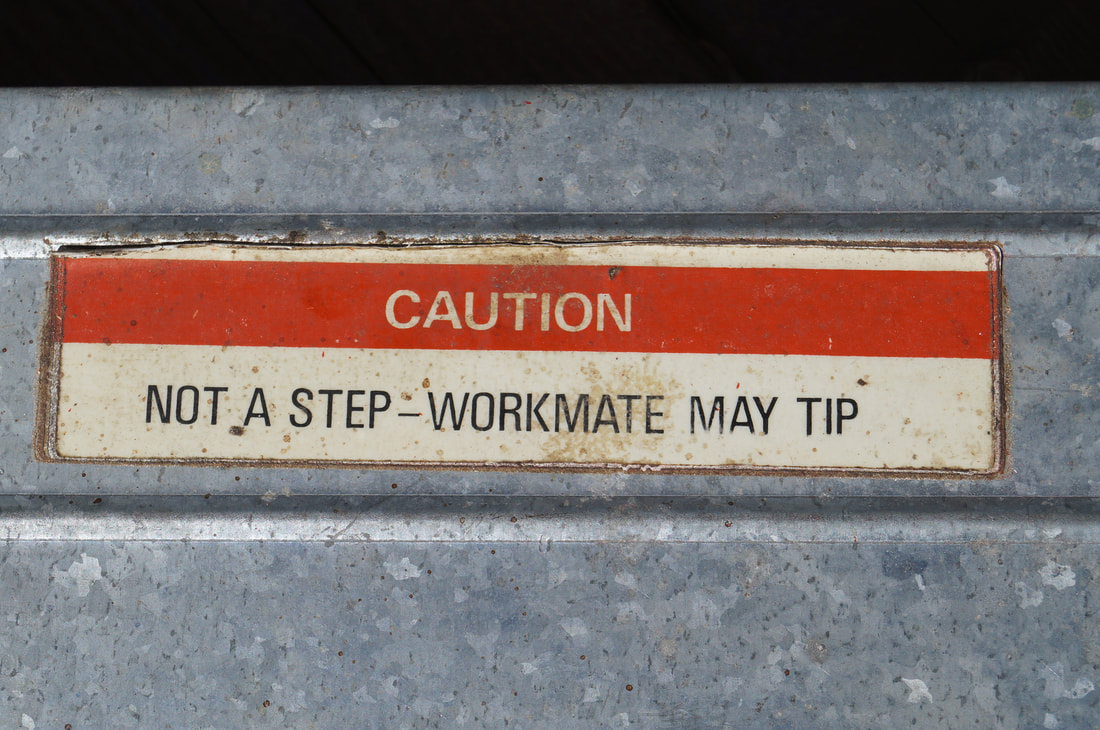
We're all aware of the many warning labels to be found on consumer products in the U.S. today. This phenomenon is attributed to strong consumer-protection laws, the litigiousness of American society, and the need for manufacturers to protect themselves. Looking at vintage Workmates provides an interesting and amusing illustration of this. If you've read about the Workmate 79-001 Type E, you know that it is the same model that was produced and sold in the U.K. as the WM325. You may also have noticed that the instruction manuals for both of these two models are available here on the Documents page. Since the two Workmates are the same, obviously Black & Decker would have used the same instruction manual in the U.S. and the U.K., right? Well, no. Take a look at the three photos below for the U.S. model 79-001 Type E. The first two are warnings from page 2 of the U.S. instruction manual, and the third is the caution label applied to the step of the Type E.
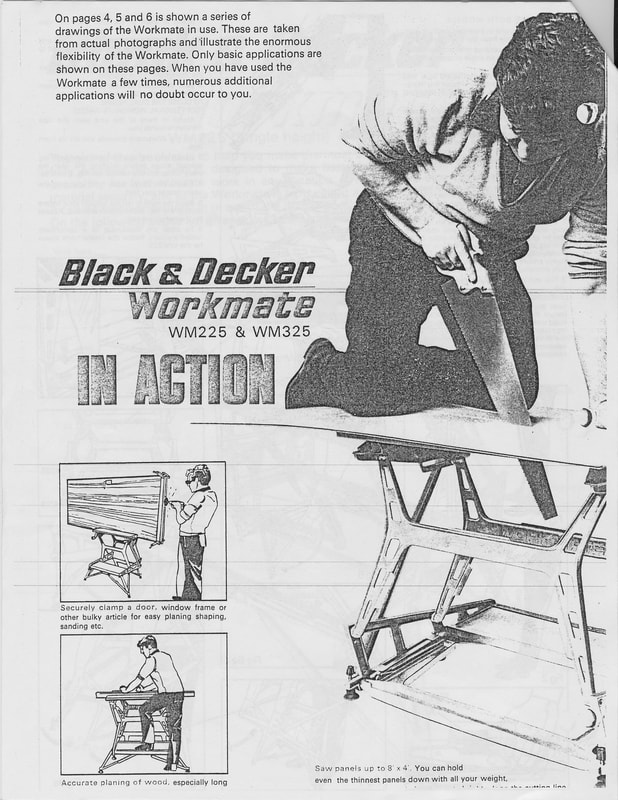
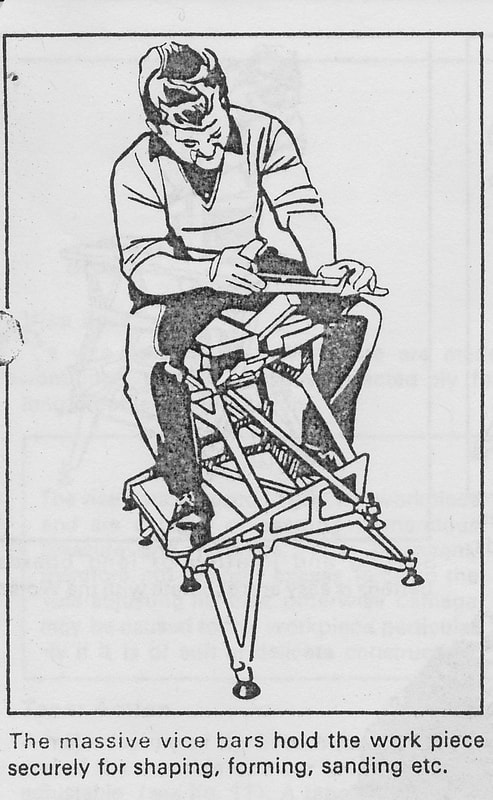
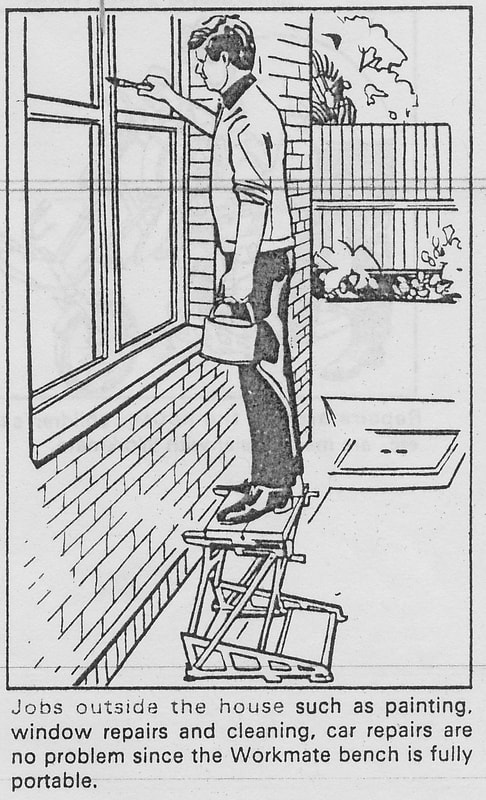
These warnings for U.S. owners are a stark contrast to the approach taken by Black & Decker in the U.K., where none of these rules or cautions had been deemed necessary for the WM325. Instead, the U.K. instruction manual illustrates a reckless British Workmate user throwing caution to the wind by using the WM325 in the following ways:
The photo on the left shows the user perched on a Workmate on hands and knees, with his full weight on top of a board that he is cutting with a hand saw. His lower legs extend off the end of the Workmate, slightly bending the board he is cutting. The middle drawing shows the user sitting on the jaws with his legs straddling the Workmate front to back while shaping a board with a rasp. And finally, the right-hand drawing shows the same user standing atop the jaws while doing some painting, with the caption assuring us that it's "no problem".
It would be interesting to know if these differences still exist in the owners' manuals for current models. If you happen to have any current users' manuals from the U.K. please leave a comment to let us know! On a related topic, you have probably noticed that most Workmate owners refer to the low horizontal panel at the front of the Workmate as a "step". This was a term that Black & Decker assiduously avoided, even in the U.K. The U.K. manual for the WM325 consistently uses the term "footboard", which at least acknowledges that you're going to place a foot on it occasionally. In the U.S. manual for the 79-001 Type E they tried to emphasize that you should not stand on it, by changing those references to "base board" and "lower platform". However, if you look carefully, you can find one spot they missed, where the U.S. manual still says "foot board". A unique characteristic of what we know as the Workmate 79-001 Type 1 is that it was never marked in any way as a "Type 1". In particular, the label on the jaws said only "#79-001 'WORKMATE'", and there was no ink stamp with the Type number underneath the jaw. This was unlike the preceding version, which was marked on both the label and the jaws as the "#79-001 Type E". It was also unlike the following version, which had "79-001 Type 2" on the label and "Type 2" under the jaws. (See the photos on the Markings page.)
So what happened to make the Type 1 different? I think this anomaly in the marking indicates that Black & Decker didn't originally intend to produce the Workmate under a series of different Type numbers. In 1974, they imported the English-made WM325 Workmate with the mostly aluminum skeleton frame to North America as a test of consumer demand. They dubbed it the 79-001, a new model designation exclusive to the U.S. market. If the test was successful, they intended to retool their factory in Canada to manufacture a redesigned version of the Workmate for North America. In this sense, the first 79-001 was a temporary product, so they labeled it the Type E (for England) to differentiate it from the new-design, mostly steel 79-001 that they had planned to follow. The market test was a huge success, production of the new mostly steel "real" 79-001 began, and Black & Decker dropped the "Type' nomenclature since it was no longer necessary. What we now know as the Type 1 was on the market as simply the Workmate 79-001, the planned model number from the beginning. However, in less than a year they made a set of further changes to the 79-001. The most significant changes were a switch to metric sizing for the jaw holes and a new type of mount for the jaws, and the new parts were not interchangeable with those of the outgoing version. To keep the versions distinct, they decided to return to the Type numbering system they had used for the Type E. Since the newest one was the second version made in Canada, it became the Type 2, and the one that it was replacing became, retroactively, the Type 1, even though it was never marked or referred to as such while it was in production. The Type 1 has a second distinction worthy of note: It is the only 79-001 that Black & Decker ever referred to by Type number in any of their instruction manuals, advertisements, or catalogs. The single reference can be found in the original version of the Gripmate 79-011 manual on page 3. |


 RSS Feed