H-FRAME
  • Home
    • About
  • workmates
    • Workmate 79-001 Type Study >
      • 79-001 type E
      • 79-001 type 1
      • 79-001 type 2
      • 79-001 type 3
      • 79-001 type 4
      • 79-001 type 5
      • 79-001 type 6
      • 79-001 type 7
      • 79-001 type 8
      • 79-001 type 9
    • Type id flowchart
    • Brockville Production Codes
    • 79-001 Timeline
    • Marks and Labels
    • Family Portrait
    • Other Related Workmates >
      • Workmate 79-004
      • Workmate 79-005
      • Jobmate 3980
      • Craftsman Portable Craft Center
    • UK & European Workmates >
      • Mate Tools Workmate
      • Workmate WM125
      • Workmate WM225/WM325
      • Workmate WM525
      • Workmate WM625
      • Wallmate FB1
    • Australian/Japanese Workmates
    • Complete Model History
    • Accessories >
      • swivel grips 79-010
      • gripmate 79-011 79-016
      • mitremate 79-012
      • routermate 79-013
      • guidemate 79-015
      • horizontal clamp 79-018
      • extender arms wm110
      • metal vice claddings wm120
      • tool tray wm130
      • saw table wm140/wm141
      • Universal baseplate wm190
    • Documents
    • Parts/Repairs >
      • Feet
      • Leg Clip Repair
      • Plastic Latch Lever Repair
      • Handle Replacement
      • Top Replacement
      • Replacement Swivel Grips
      • Mitremate Brackets
      • 3D-Printed Parts
    • Links
  • Blog
  • Contact

The Unofficial Workmate Blog:

What's the most common Workmate 79-001?

1/11/2024

 
Many Workmate fans have a general idea of which 79-001's are easiest and hardest to find these days, but so far no one has quantified this. After more than three years of collecting data about 79-001's provided to me from their owners or listed for sale around the U.S. and Canada on the usual sites, I'm confident enough to give some estimates.  The following is based on detailed observations I have collected on about 700 Workmate 79-001's, supplemented with casual browsing of a couple thousand more.

Although I'm giving you specific percentages here, realize that these are rough estimates, with an unknown standard error, so feel free to expand them to sensible percentage ranges if you wish.


The Type 2 is far and away the most common 79-001, accounting for very roughly 43% of those found today. This makes sense because it had the longest production period of all the Types, from May 1975 to June 1977.

Second most common is the Type 4, at very roughly 21% of all 79-001's. The Type 2 and Type 4 together comprise almost 2/3 of the 79-001's I have found.

Next most common, vying for third, fourth, and fifth places, are the Type 6, Type 7, and Type 8, at about 8 to 10% each. That means the five most common Types—Type 2, Type 4, Type 6, Type 7, and Type 8—make up about 90% of the ten Types of the 79-001.

That leaves the other five Types as rare ones. Almost half of those are Type 1's, putting it in sixth place at perhaps 4% of the overall numbers.

Three more compete for seventh, eighth, and ninth places at about 2% each. One of these is the rarest Type manufactured in North America, the 79-001 Type 9. The other two were made in England and Ireland—the Type E and the Type 3 respectively.

That brings us to tenth place, but wait—if you've been keeping track, you realize that the estimates I present above have already totaled 100%. My rough estimate is that there are so few of the made-in-Ireland 79-001 Type 5 out there that it would barely be the rounding error on estimates of the other Types. I'll just call it less than .5% of the overall quantity, and I actually doubt it is more than .25%. In years of looking, I have found just four 79-001 Type 5's, and I currently own two of them!

From the Original U.S. Marketing Manager!

5/14/2021

 
As you can imagine, I often search the web for Workmate-related information. One of the most remarkable things I have come across is a short recollection written by the original marketing manager for the Workmate in the United States.

I found this in the comment section of a posting about the Workmate at the "toolmonger" blog. The blog appears to have been inactive since 2014 although the web site is still functioning as I write this. I didn't want to take a chance on it being deleted so I'm reproducing the posted comment below in its entirety, with numerous typos left intact. The poster gave his name only as "Thomas", posting the following on July 8, 2012:
I love seeing all the positive comments about the Workmate as I was the Markeeting Mgr. for the Professsional Div. when the first 6-units were imported from England. I thought it was great but corporate thinking at the time was if it does’t have a motor or attach to a tool with a motor, we don’t need it, The President, Pat McDonough gave a few of us in marketing units to use and familiarize ourselves with. But, I was the only one who liked it and saw major possibilities for sales.

The original units were made in England using all aluminum castings and were beauties to behold.FYI, the UK company projected sales of 50,000 pcs first year at the US ewuivakant of $85, a large chuunk of disable income over there then and lo and bdhold they sold 3oo,ooo pcs first year.

when I got mine I had it included in equipment to be shipped around to a series of regional sales meeting around the country,,,to e used as a prop for the introduction of the Mod 4, cordless tool line to the sales force, (Mod 4 was the first cimercislly availsble line of Cordless tools) I got laughed at for using it to hold wod, steel & aluminum samples for the salesmen to drill holes in using the new tools, But, I got the last laugh when in a 5,ooo unit market test in Dallas, they evaporated off the shelves overnight.

I was the first workmate champion in the company but as soon as they started selling our President took it away from me and the Professional Div. and forced the Home Products guys to take it over, The rest is history as B& D had to build 3 mfg plants to keep up with demand.

I still have my one of the originak 6 abd it needs restoration but it is a reak nice piece of B&D history. You have to understand, corporate thinking frowned on any new product that didn’t use a B&D ekectric motor so to force it through and get the ckearances needed for me to use it in sales meetings, even as a prop, was qite q feat of which I am very proud, SO yes, these many years later, I am thrilled to lnow that my gut instinct was right, you guys like it and it’s still it’s is one heck of a product!

one workmate, two different cultures

3/24/2020

 
We're all aware of the many warning labels to be found on consumer products in the U.S. today. This phenomenon is attributed to strong consumer-protection laws, the litigiousness of American society, and the need for manufacturers to protect themselves. Looking at vintage Workmates provides an interesting and amusing illustration of this.

If you've read about the Workmate 79-001 Type E, you know that it is the same model that was produced and sold in the U.K. as the WM325. You may also have noticed that the instruction manuals for both of these two models are available here on the Documents page. Since the two Workmates are the same, obviously Black & Decker would have used the same instruction manual in the U.S. and the U.K., right? Well, no.

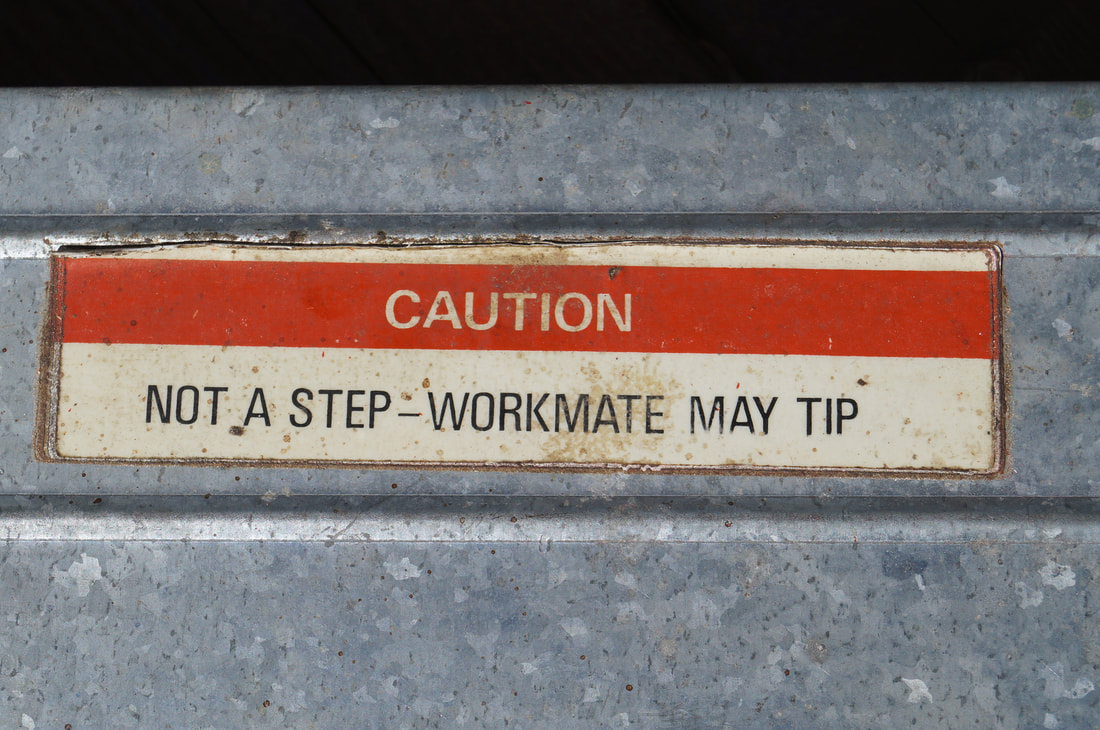
Take a look at the three photos below for the U.S. model 79-001 Type E. The first two are warnings from page 2 of the U.S. instruction manual, and the third is the caution label applied to the step of the Type E.

Picture
Picture
Picture
These warnings for U.S. owners are a stark contrast to the approach taken by Black & Decker in the U.K., where none of these rules or cautions had been deemed necessary for the WM325.

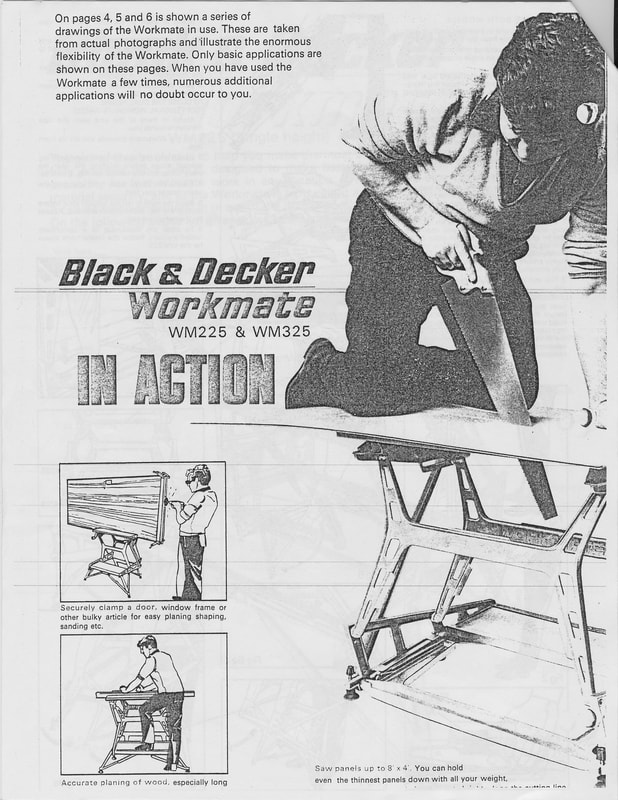
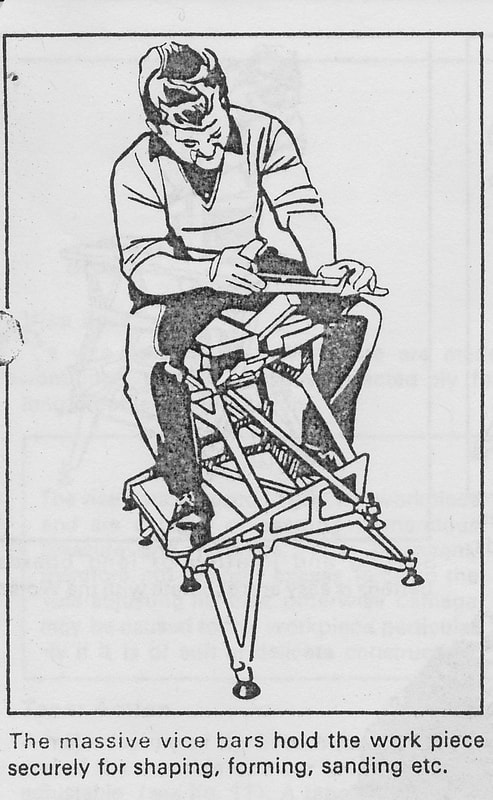
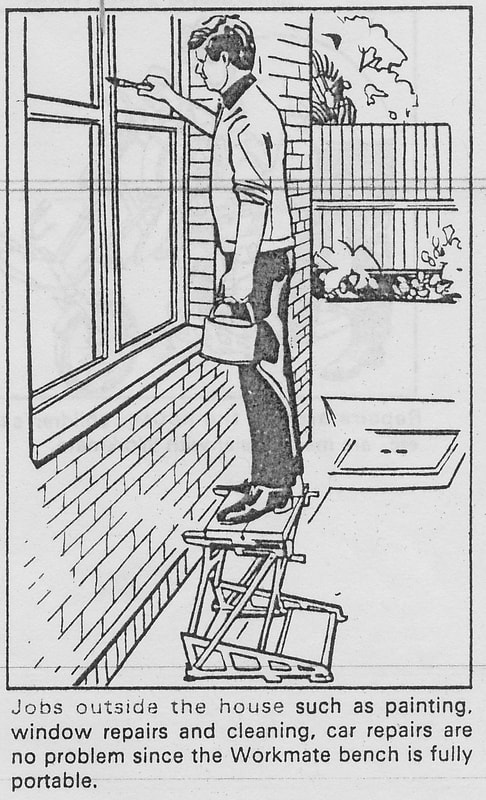
Instead, the U.K. instruction manual illustrates a reckless British Workmate user throwing caution to the wind by using the WM325 in the following ways:

Picture
Caption at bottom: "Saw panels up to 8'x4'. You can hold even the thinnest panels down with all your weight"
Picture
Picture
The photo on the left shows the user perched on a Workmate on hands and knees, with his full weight on top of a board that he is cutting with a hand saw. His lower legs extend off the end of the Workmate, slightly bending the board he is cutting. The middle drawing shows the user sitting on the jaws with his legs straddling the Workmate front to back while shaping a board with a rasp. And finally, the right-hand drawing shows the same user standing atop the jaws while doing some painting, with the caption assuring us that it's "no problem".

It would be interesting to know if these differences still exist in the owners' manuals for current models. If you happen to have any current users' manuals from the U.K. please leave a comment to let us know!

On a related topic, you have probably noticed that most Workmate owners refer to the low horizontal panel at the front of the Workmate as a "step". This was a term that Black & Decker assiduously avoided, even in the U.K.

The U.K. manual for the WM325 consistently uses the term "footboard", which at least acknowledges that you're going to place a foot on it occasionally.

In the U.S. manual for the 79-001 Type E they tried to emphasize that you should not stand on it, by changing those references to "base board" and "lower platform". However, if you look carefully, you can find one spot they missed, where the U.S. manual still says "foot board".

    Archives

    April 2024
    January 2024
    December 2022
    January 2022
    May 2021
    December 2020
    September 2020
    April 2020
    March 2020
    February 2020
    January 2020

    Categories

    All
    79 001
    Buying
    Feet
    Mate Tools
    Production Dates
    Prototype
    Ron Hickman
    Type 1
    Type 2
    Type 3
    Type 5
    Type E
    WM125
    Workmate

    RSS Feed

  • Home
    • About
  • workmates
    • Workmate 79-001 Type Study >
      • 79-001 type E
      • 79-001 type 1
      • 79-001 type 2
      • 79-001 type 3
      • 79-001 type 4
      • 79-001 type 5
      • 79-001 type 6
      • 79-001 type 7
      • 79-001 type 8
      • 79-001 type 9
    • Type id flowchart
    • Brockville Production Codes
    • 79-001 Timeline
    • Marks and Labels
    • Family Portrait
    • Other Related Workmates >
      • Workmate 79-004
      • Workmate 79-005
      • Jobmate 3980
      • Craftsman Portable Craft Center
    • UK & European Workmates >
      • Mate Tools Workmate
      • Workmate WM125
      • Workmate WM225/WM325
      • Workmate WM525
      • Workmate WM625
      • Wallmate FB1
    • Australian/Japanese Workmates
    • Complete Model History
    • Accessories >
      • swivel grips 79-010
      • gripmate 79-011 79-016
      • mitremate 79-012
      • routermate 79-013
      • guidemate 79-015
      • horizontal clamp 79-018
      • extender arms wm110
      • metal vice claddings wm120
      • tool tray wm130
      • saw table wm140/wm141
      • Universal baseplate wm190
    • Documents
    • Parts/Repairs >
      • Feet
      • Leg Clip Repair
      • Plastic Latch Lever Repair
      • Handle Replacement
      • Top Replacement
      • Replacement Swivel Grips
      • Mitremate Brackets
      • 3D-Printed Parts
    • Links
  • Blog
  • Contact